What If Your Morning Screen Time Could Bring You Closer to Your Kids?
We’ve all been there—scrolling through news or messages while helping kids get ready for school, feeling torn between staying informed and being present. That time often feels wasted or even guilty. But what if those few morning minutes in front of your phone didn’t pull you apart, but actually helped you connect? Imagine opening an app not for distraction, but to spark real conversation with your child before the day begins. What if the screen in your hand could become a bridge instead of a barrier? It’s not magic. It’s thoughtful tech—designed not to steal your attention, but to share it.
The Morning Rush: When Screens Pull Families Apart
Mornings in most homes feel like a race against the clock. You're half-awake, pouring coffee while one hand zips a backpack, the other stirs oatmeal. Your teenager is buried in a hoodie, headphones on, eyes down. Your younger one is hopping on one foot, trying to put on a shoe while holding a juice box. And you? You're glancing at your phone—just a quick check. A weather update. A text from your mom. A news headline that makes you pause. It feels necessary, but also… hollow. You know you should be more present, but presence doesn’t pay the bills or keep you informed. Still, that little tug in your chest remains—the guilt of being physically there but mentally somewhere else.
It's not that we don’t love being with our kids. We do. But the morning routine is a battlefield of tasks, and screens have quietly become both our allies and our enemies. They help us manage schedules, respond to work emails, and stay connected to the world. Yet, too often, they pull us away from the people right in front of us. We've all seen it—the parent scrolling at the breakfast table while the child waits silently, the family in the car, each person staring at a separate screen. These aren’t bad people. They’re busy, tired, trying to do it all. But over time, those small moments of disconnection add up. What starts as a quick glance at a notification can become a habit of emotional distance. And the sad truth? Our kids notice. They may not say it, but they feel it when we're not really there.
That’s why rethinking how we use tech in these early hours matters. It’s not about banning phones or pretending we can live without them. It’s about asking: how can we use them differently? What if, instead of being a wall between us and our children, our devices could become a doorway?
A New Kind of App: Designed for Conversation, Not Consumption
Imagine opening your phone and instead of a flood of updates, ads, and alerts, you see just one thing: a simple question. 'If you could invent a new holiday, what would it be?' That’s it. No likes, no shares, no algorithm deciding what you should care about. Just a prompt—something light, fun, and open-ended. And the best part? It’s meant to be read out loud. To your child. Over breakfast. That’s the idea behind a new wave of apps built not for endless scrolling, but for real human connection.
These aren’t social media platforms or news aggregators. They’re something quieter, gentler, and far more intentional. Think of them as digital conversation starters—tools designed to spark dialogue, not distract from it. One mom in Ohio told me she started using one after her 8-year-old said, 'You always look at your phone more than me.' That hit hard. She downloaded an app that delivers one family-friendly question every morning. The first day, she read it aloud: 'Would you rather have a pet dragon or a talking dog?' Her son laughed, then launched into a five-minute story about how a talking dog could help him with homework. They talked all the way to the bus stop.
What’s powerful here isn’t the technology itself—it’s the shift in intention. Instead of using your phone to escape or catch up, you’re using it to engage. The screen becomes a shared space, not a private one. And because the content is designed for interaction, it invites participation. No one’s expected to perform or post. There’s no pressure to get the 'right' answer. It’s just a starting point for connection. These apps don’t feed you outrage or urgency. They offer curiosity. Wonder. Play. And in a world that often feels too serious, that’s a gift.
How These Platforms Work—Without Taking Over Your Morning
You might be wondering—won’t this just add another thing to my already crowded morning? Another app to check, another notification to manage? That’s a fair concern. But these conversation apps are built with busy families in mind. They’re simple by design. No sign-up walls, no endless menus, no push notifications at 6:03 a.m. Most work like this: you open the app, and one question appears. That’s it. No scrolling. No decisions. Just a single prompt, refreshed each day.
Some let you customize the tone or difficulty—gentler questions for younger kids, deeper ones for teens. One app even lets you tag topics your family loves—animals, space, food—and tailors the questions accordingly. But the core experience stays the same: quick, calm, and focused. You don’t need to spend time setting it up every morning. It’s ready when you are. And because there’s only one question, it doesn’t invite distraction. There’s nothing else to click on. No 'see more' button. No autoplay videos. It’s the opposite of how most tech works today. Instead of pulling you in, it gives you something useful and then steps back.
The real magic is in how it changes your relationship with the device. Instead of hunching over your phone in silence, you’re holding it where both you and your child can see it. You read the question together. You take turns answering. Maybe you even argue good-naturedly about whether a robot chef would be helpful or just annoying. The phone becomes a tool for shared attention, not divided focus. And that’s a big shift. Because it’s not about eliminating screen time—it’s about transforming it. From something isolating into something inclusive. From solo scrolling to side-by-side sharing.
Turning Minutes into Meaning: Real Parent-Child Moments
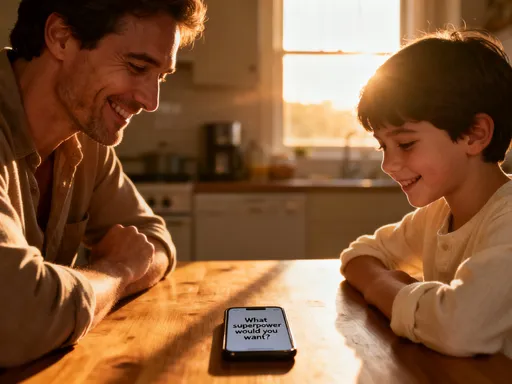
Let’s picture a real morning. You’re at the kitchen table. Toast is popping up. Juice is being poured. Your 10-year-old is dragging her feet, still in pajamas. You open the app and read: 'What superpower would help you most at school?' She groans at first—'Mom, really?'—but then pauses. 'Hmm. Maybe the power to read minds. Then I’d know if my teacher is about to give a pop quiz.' You laugh. 'But wouldn’t that be kind of stressful? What if you heard everyone’s thoughts at once?' She thinks. 'Okay, maybe time freeze. So I could finish my math test without rushing.' Now you’re both imagining it—how she’d pause time, walk around the classroom, peek at answers (just kidding!), grab a snack from the kitchen. The conversation flows. It’s silly, but it’s also telling. You’re learning something about her—she feels rushed. She’s anxious about tests. And she’s creative. All from one question.
Another family in Colorado uses the app during their car ride to school. One morning, the question was: 'Would you rather live in the ocean or in space?' The 7-year-old chose space—'Because I could float and have zero gravity battles!' His older sister said ocean—'Because I could ride a dolphin and explore shipwrecks.' Their mom asked, 'What would you miss most about Earth if you lived there?' That led to a 15-minute talk about missing family, pets, and pizza. It wasn’t deep in the traditional sense, but it was meaningful. They were listening. They were imagining together. They were connecting.
These aren’t grand moments. They don’t make the news. But they’re the kind of small, warm interactions that build a childhood. And they happen because someone asked a simple question at the right time. No prep. No pressure. Just presence, guided by a little tech nudge. Over time, these micro-moments become a rhythm. A habit of talking, not just coexisting. And that changes the emotional climate of a home.
Building Emotional Connection One Question at a Time
Here’s what surprised me most when I talked to parents using these apps: it’s not just about fun conversations. It’s about feeling closer. More in tune. One mom in Texas said, 'I realized I knew my daughter’s schedule—soccer on Tuesdays, piano on Thursdays—but I didn’t really know her. Like, what does she worry about when she can’t sleep? What makes her proud?' After a few weeks of morning questions, she learned that her daughter sometimes feels left out at lunch, that she secretly writes stories in a notebook, and that she thinks kindness is the most important superpower. 'I never would’ve asked her that directly,' she said. 'It feels too heavy for a busy morning. But the app made it easy. It felt light.'
That’s the power of low-pressure dialogue. When a question comes from an app, it doesn’t feel like an interrogation. It’s not 'So, how’s school?'—which can sound like 'Tell me everything, and make it quick.' It’s playful. Inviting. It gives kids space to share on their terms. And when they do, they feel seen. Heard. Valued. That builds trust. And trust builds connection. Over time, parents start to see their kids not just as responsibilities or roles—student, sibling, athlete—but as full people, with thoughts, feelings, and dreams of their own.
And it works both ways. Kids begin to see their parents as more than rule-enforcers or ride providers. They see them as people with opinions, humor, and even uncertainties. When a dad answers, 'I’d want the power to teleport so I wouldn’t be late picking you up,' it’s funny, but it’s also honest. It shows he cares about being on time. It humanizes him. These moments of mutual sharing—small as they are—create emotional safety. A home where it’s okay to talk. Where curiosity is welcome. Where silence isn’t the default.
Making It a Habit: Fitting Tech Into Your Family Rhythm
Like any good habit, this one works best when it’s woven into your existing routine. You don’t need to reinvent your morning. Just tweak it. Start by placing your phone where both you and your child can see it—on the breakfast table, propped up next to the cereal box. Make it part of the ritual. Some families pair it with pouring coffee or juice—'First juice, then question.' Others do it while packing lunches. The key is consistency, not perfection. Even if you only do it three mornings a week, that’s nine meaningful conversations a month. That’s not nothing.
Set a loose rule—two minutes, tops. You’re not trying to solve world peace. Just spark a moment. Let your child read the question sometimes. Let them pick which days to use it. Give them ownership. One dad lets his son choose whether to answer the question or pass. 'No pressure,' he says. 'But 90% of the time, he answers anyway.' That’s the beauty of it—when kids feel in control, they’re more likely to engage.
If mornings are too chaotic, try it at dinner or bedtime. The timing matters less than the intention. What matters is that it becomes a shared pause—a small pocket of time where you’re not rushing, not correcting, not planning. Just being together, with a little help from tech. And if you miss a day? No guilt. Just try again tomorrow. This isn’t about adding pressure. It’s about adding connection. One question, one breath, one smile at a time.
Beyond the Morning: How Small Shifts Create Lasting Change
Here’s the thing about small habits—they grow. That morning question about superpowers might lead to a bedtime chat about fears. The talk about invented holidays might inspire a family project—designing your own celebration with homemade decorations and a special meal. These tiny moments of connection don’t just vanish by lunchtime. They linger. They build a foundation of openness. Over time, kids start to bring up things they wouldn’t have before. A tough day at school. A friendship that’s changing. A dream they’re afraid to share.
And parents become better listeners. Not because they took a class, but because they’ve practiced. They’ve learned to wait. To smile. To say, 'Tell me more.' The home becomes a place where feelings aren’t buried under busyness. Where curiosity is rewarded. Where silence is filled not with screens, but with stories. One mother told me, 'We used to eat dinner in front of the TV. Now we talk. Sometimes it’s messy. Sometimes no one has much to say. But we’re trying. And it feels more like a family.'
That’s the real win here. It’s not about the app. It’s about what the app helps you remember—that connection doesn’t require grand gestures. It doesn’t need perfect timing or special skills. It just needs a little intention. A question. A shared glance. A moment of presence. And sometimes, the very tool we blame for pulling us apart can, when used with care, bring us closer together. So the next time you reach for your phone in the morning, ask yourself: could this moment be more than a scroll? Could it be a spark? Because your child is sitting right there. And they’re ready to talk—if you’re ready to listen.